Whey Protein Concentrate - Unflavored - Choose Size
Scientific Name: Mixture of proteins from whey
Origin: USA
Product Overview
Whey Protein Concentrate has a legitimate place in THP's Weight Management, Sports Nutrition and Fitness collections.
For customers who go to the gym, the strongest benefits to highlight are muscle protein synthesis, recovery after resistance training, meeting daily protein requirements, preserving muscle during weight loss and supporting muscle growth when combined with progressive training.
Unlike fat-burning supplements, whey protein works primarily by improving protein intake and supporting body composition.
Whey Protein Concentrate
Whey Protein Concentrate (WPC) is a high-quality milk-derived protein containing all nine essential amino acids required for normal protein synthesis, muscle maintenance and recovery.
It is particularly valued by gym enthusiasts, bodybuilders, athletes and physically active individuals because it provides a convenient source of protein to complement training and daily nutrition.
Whey protein is naturally rich in branched-chain amino acids (BCAAs), including leucine, which plays an important role in stimulating muscle protein synthesis.
Whether your goal is to build muscle, improve body composition, maintain lean muscle while losing weight or meet your daily protein requirements, Whey Protein Concentrate can be a practical addition to a balanced diet.
KEY BENEFITS
Supports Muscle Growth and Development
Provides essential amino acids required for muscle protein synthesis, particularly when combined with progressive resistance training.
Supports Post-Workout Muscle Recovery
Supplies amino acids used in repairing and rebuilding muscle proteins after exercise.
Helps Preserve Lean Muscle During Weight Loss
Adequate protein intake helps reduce the loss of muscle mass during calorie restriction, particularly when combined with resistance exercise.
Supports Healthy Weight Management
Protein can increase fullness and help manage appetite. When incorporated into a calorie-controlled diet, whey protein may support improvements in body composition.
Supports Strength Training and Bodybuilding
Provides a convenient protein source for people working towards muscle hypertrophy, strength development and improved physique.
Provides All Nine Essential Amino Acids
Whey is a complete protein, supplying amino acids that the body cannot manufacture in sufficient amounts.
Supports Daily Protein Requirements
Useful for people who struggle to obtain sufficient protein from their usual meals, including busy individuals and physically active adults.
Supports Muscle Maintenance During Ageing
Adequate dietary protein, together with resistance training, helps maintain muscle mass and physical function as people age.
WHY CHOOSE THP WHEY PROTEIN CONCENTRATE?
- Complete milk-derived protein containing all nine essential amino acids
- Naturally provides BCAAs, including leucine
- Convenient addition to gym, bodybuilding and fitness nutrition routines
- Suitable for customers seeking to increase their daily protein intake
- Can complement both muscle-building and weight-management programmes
FREQUENTLY ASKED QUESTIONS
What is Whey Protein Concentrate?
Whey Protein Concentrate is a protein ingredient obtained from whey, the liquid portion of milk separated during cheese production.
It undergoes processing to concentrate the protein while retaining varying amounts of lactose, fat and other milk components.
What is the difference between Whey Protein Concentrate and Whey Protein Isolate?
Both are complete milk-derived proteins.
Whey Protein Concentrate generally contains more lactose and fat and a lower percentage of protein by weight.
Whey Protein Isolate undergoes additional processing to remove more lactose and fat, resulting in a higher protein concentration.
Both can support muscle growth when they provide sufficient high-quality protein.
People with lactose intolerance may tolerate some whey isolates better than concentrates.
How does Whey Protein Concentrate help build muscle?
Resistance training stimulates muscle adaptation, while dietary protein supplies the amino acids needed for muscle protein synthesis.
Whey contains all nine essential amino acids and is naturally rich in leucine, which helps stimulate the muscle protein synthesis process.
When combined with consistent resistance training and adequate overall nutrition, whey protein can support increases in muscle mass and strength.
Can Whey Protein Concentrate help with healthy weight gain?
Yes. Whey Protein Concentrate can support healthy weight gain by providing additional protein and calories when incorporated into a diet that supplies more energy than the body uses.
It is particularly useful for customers seeking to build muscle, increase body weight or improve their physique through resistance training.
Whey protein does not independently cause weight gain. Consistently consuming enough total calories is essential.
How can I use Whey Protein Concentrate to gain weight?
For many healthy adults pursuing intentional weight gain, a practical starting point is to consume approximately 300–500 additional calories daily, alongside sufficient protein and a structured resistance-training programme.
Whey protein can be mixed into milk, smoothies, oats or other foods to increase protein intake.
Combining whey with calorie-dense ingredients such as bananas, peanut butter, oats or yoghurt can make it easier to increase total calorie intake.
Track body weight and training progress, adjusting food intake gradually as needed.
Can Whey Protein Concentrate help skinny people gain weight?
Yes. People who struggle to gain weight may find whey protein useful as part of a higher-calorie diet.
For those who become full quickly, a calorie-dense whey smoothie between meals can provide additional energy without requiring another large meal.
However, adequate calories are essential. Simply adding whey protein without increasing overall energy intake may not result in weight gain.
Example: Homemade weight-gain whey shake
Whey powder providing 25 g protein
1 medium banana
250 ml whole milk
40 g dry oats
1 tablespoon peanut butter
Approximate nutrition, using typical ingredient values; verify against the actual whey label.
~620 Calories ~43 g Protein ~70 g Carbohydrates
This is a useful addition between meals, rather than replacing a normal meal, for someone struggling to consume enough calories. For lactose-intolerant customers, a lactose-free alternative may be more suitable, although whey concentrate itself still contains lactose.
Can Whey Protein Concentrate help me gain muscle instead of belly fat?
Whey Protein Concentrate supplies amino acids that support muscle protein synthesis.
When combined with progressive resistance training, adequate calories and sufficient recovery, it can support muscle development.
However, no supplement guarantees that all weight gained will be muscle.
A moderate calorie surplus and consistent strength training can help limit unnecessary fat gain.
Can I use Whey Protein Concentrate for both weight loss and weight gain?
Yes. Whey protein can support either goal, depending on the overall diet.
For weight loss, it can help maintain protein intake and preserve muscle during a calorie deficit.
For weight gain, it can help meet protein requirements while additional calories support muscle development and increased body weight.
The determining factors are total calorie intake, protein intake, physical activity and individual nutritional needs.
Is Whey Protein Concentrate good for bodybuilders and gym enthusiasts?
Yes. Whey Protein Concentrate can help bodybuilders and gym enthusiasts meet the increased protein requirements associated with regular resistance training.
It can support muscle development during a muscle-building phase and help preserve lean mass during a calorie-controlled cutting phase.
Training consistency, sufficient calories, progressive overload and recovery remain essential.
How much whey protein powder is in one teaspoon?
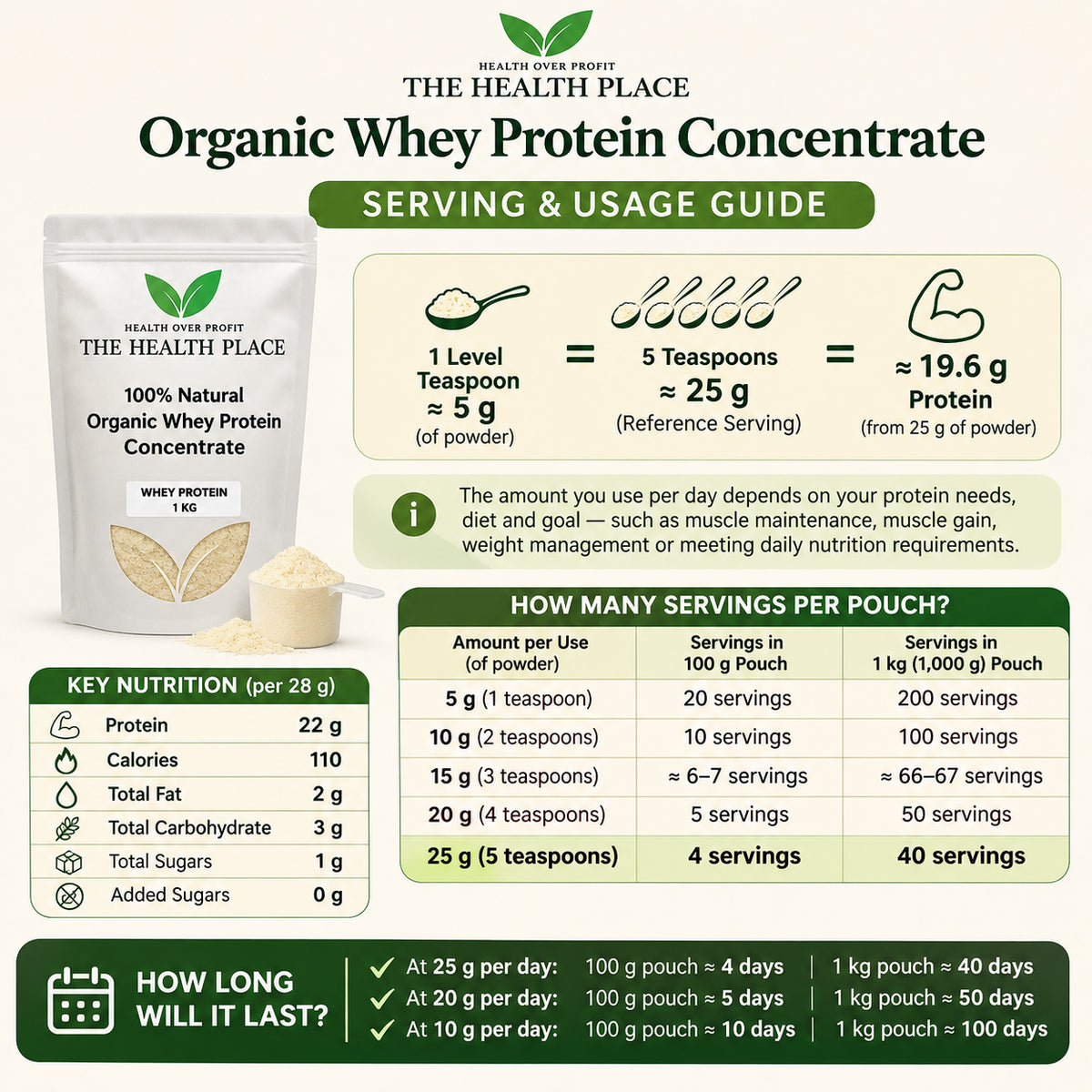
For easy portion planning, you can estimate one level teaspoon as approximately 5g of whey protein powder.
This is only a rough estimate because powder density varies. For accurate measurements, use a kitchen scale.
How many teaspoons make one serving?
We suggest using 25g (approximately five estimated teaspoons) as a convenient reference portion.
However, you do not have to consume 25g at once. The amount you use depends on your individual protein requirements, diet and fitness goals.
How many servings are in a 100g pouch?
It depends on how much you use each time.
- At 5g per use: 20 portions
- At 10g per use: 10 portions
- At 15g per use: approximately 6–7 portions
- At 20g per use: 5 portions
- At 25g per use: 4 portions
How many servings are in a 1kg pouch?
A 1kg pouch contains 1,000g of whey protein powder.
- At 5g per use: 200 portions
- At 10g per use: 100 portions
- At 15g per use: approximately 66–67 portions
- At 20g per use: 50 portions
- At 25g per use: 40 portions
How long will my whey protein last?
The table below shows how long each pouch lasts if you use the stated quantity once daily.
|
Daily powder intake |
100g pouch |
1kg pouch |
|
5g |
20 days |
200 days |
|
10g |
10 days |
100 days |
|
15g |
About 6–7 days |
About 66–67 days |
|
20g |
5 days |
50 days |
|
25g |
4 days |
40 days |
|
30g |
About 3–4 days |
About 33–34 days |
Do I have to use 25g of whey protein every day?
No. The 25g portion is simply a convenient reference for measuring your powder.
Your ideal intake depends on how much protein you already obtain from food and whether your goal is muscle maintenance, muscle gain, weight management or meeting your daily nutritional needs.
You can use smaller or larger quantities according to your requirements.
How much protein am I actually getting?
THP Organic Whey Protein Concentrate provides approximately 79% protein by weight.
- 5g powder provides approximately 3.9g protein.
- 10g powder provides approximately 7.9g protein.
- 15g powder provides approximately 11.8g protein.
- 20g powder provides approximately 15.7g protein.
- 25g powder provides approximately 19.6g protein.
- 30g powder provides approximately 23.6g protein.
Is 25g of powder the same as 25g of protein?
No. A 25g portion of whey protein concentrate provides approximately 19.6g of actual protein.
The remainder consists of naturally occurring components of whey concentrate, including small amounts of fat, carbohydrates and minerals.
Can Whey Protein Concentrate help with weight loss?
Yes. Whey Protein Concentrate can support weight-management efforts when incorporated into an appropriate diet.
Protein-rich foods and supplements can increase fullness, making it easier for some people to manage their overall food intake.
Adequate protein also helps preserve lean muscle during weight loss, particularly when combined with resistance training.
However, whey protein does not automatically cause weight loss. Total calorie intake remains important, and adding protein shakes without adjusting the rest of the diet may increase calorie consumption.
For sustainable weight management, focus on these eight practices:
1. Consider Intermittent Fasting, If Suitable
An optional 12–16-hour overnight fasting window may help some people manage their eating schedule.
Fasting is not appropriate for everyone. Pregnant women, people with a history of eating disorders and those taking medication that may cause low blood sugar should seek medical advice before fasting.
2. Practise Portion Control
Manage serving sizes and maintain an appropriate overall calorie intake without severe restriction.
3. Prioritise Protein and Vegetables
Include protein-rich foods such as eggs, fish, poultry, lean meat, beans and appropriate protein supplements, alongside vegetables and suitable carbohydrate portions.
4. Walk and Stay Physically Active
Increase daily walking according to your ability. A target of 10,000 steps is optional rather than mandatory.
Include resistance training to preserve or develop muscle mass.
5. Support Digestion and Bowel Regularity
Drink sufficient water, consume fibre-rich foods you tolerate and maintain regular physical activity.
6. Investigate Blood Sugar and Hormonal Concerns When Appropriate
Persistent unexplained weight changes, fatigue or other symptoms may warrant medical assessment, including blood sugar, thyroid or hormonal investigations when clinically indicated.
7. Reduce Added Sugar and Refined Carbohydrates
Limit sugary drinks, sweets and excessive refined carbohydrate portions while choosing balanced meals.
8. Prioritise Quality Sleep
Aim for approximately 7–9 hours of quality sleep each night to support recovery, appetite regulation and overall health.
Can Whey Protein Concentrate burn belly fat?
Whey Protein Concentrate cannot selectively burn abdominal fat.
However, adequate protein intake can support overall fat-loss programmes by helping preserve lean muscle and, for some people, improving fullness.
Abdominal fat includes two main types:
Subcutaneous fat: Fat stored beneath the skin.
Visceral fat: Fat surrounding internal organs. Excess visceral fat is associated with increased cardiometabolic risk.
Fat distribution is influenced by genetics, age, hormonal changes, body composition and overall energy balance.
Can sit-ups or abdominal exercises remove belly fat?
Abdominal exercises strengthen the muscles beneath the fat but do not selectively eliminate abdominal fat.
What helps reduce belly fat?
A sustainable calorie deficit, adequate protein intake, regular walking, resistance training and sufficient sleep can support overall fat loss, including reductions in abdominal fat over time.
Whey protein can help people meet their protein needs during this process, but it is not a fat burner.
Bloating and constipation can also change abdominal appearance without representing an increase in body fat.
Can Whey Protein Concentrate help preserve muscle during a calorie deficit?
Yes. During weight loss, the body may lose both fat and lean tissue.
Adequate protein intake, combined with resistance training, helps preserve muscle mass while body weight decreases.
Whey protein provides a convenient way to meet protein requirements when calorie intake is reduced.
Is Whey Protein Concentrate useful during bulking and cutting?
Yes. During bulking: Whey protein can help meet the protein requirements needed to support muscle development alongside resistance training and sufficient calories.
During cutting: Whey protein can help maintain protein intake while calories are reduced, supporting muscle preservation during fat loss.
The overall diet and training programme determine the results.
Does Whey Protein Concentrate help with muscle recovery after exercise?
Whey provides amino acids used in muscle protein repair and remodelling following exercise.
Consuming adequate protein throughout the day supports recovery and adaptation to training.
However, protein supplementation does not guarantee the absence of muscle soreness or faster recovery after every workout.
When is the best time to take Whey Protein Concentrate?
Whey protein can be consumed after exercise, between meals or at another convenient time.
Post-workout consumption is practical, but meeting your total daily protein requirement is generally more important than taking whey within a narrow post-exercise window.
How much protein do gym enthusiasts need?
For many healthy adults engaged in regular resistance training, approximately 1.4–2.0 grams of protein per kilogram of body weight per day is a commonly used sports nutrition range.
For example, a person weighing 70 kg would calculate:
70 × 1.4 = 98 g of protein daily.
70 × 2.0 = 140 g of protein daily.
This gives an approximate range of 98–140 g of total daily protein from food and supplements.
Individual requirements vary according to training intensity, age, calorie intake and medical circumstances.
How much Whey Protein Concentrate should I take per serving?
Many adults use servings that provide approximately 20–40 g of protein, depending on their daily requirements and the protein already obtained from food.
The amount of powder needed depends on the protein percentage of the particular product.
Can women use Whey Protein Concentrate?
Yes. Whey protein can support protein intake, muscle maintenance and recovery in women who exercise regularly.
It does not automatically cause excessive muscle growth. Muscle development depends on training, nutrition, genetics and other factors.
Can women in menopause benefit from Whey Protein Concentrate?
Yes. Ageing and menopause are associated with changes in muscle mass, body composition and physical function.
Adequate protein intake and resistance training can help support muscle maintenance and strength during this stage of life.
Whey protein can be a convenient way to meet protein requirements, although it is not a treatment for menopausal symptoms.
Can older adults benefit from Whey Protein Concentrate?
Yes. Older adults may benefit from adequate high-quality protein intake, particularly when combined with resistance exercise.
Whey protein can help meet dietary protein requirements when appetite or food intake is limited.
Individual needs should be assessed, especially when significant medical conditions are present.
Can Whey Protein Concentrate help with appetite control?
Protein generally promotes greater fullness than some lower-protein foods or beverages.
Whey protein may help with appetite management when used as part of a balanced diet.
However, its effect varies between individuals, and it does not eliminate hunger or guarantee reduced calorie intake.
Can Whey Protein Concentrate replace a meal?
Whey Protein Concentrate provides protein but is not necessarily a complete meal.
A balanced meal also supplies carbohydrates, fats, fibre, vitamins and minerals.
Whey can be incorporated into a more complete smoothie or meal, but plain whey protein should not routinely replace balanced meals without considering overall nutrition.
Can Whey Protein Concentrate be taken without going to the gym?
Yes. Whey protein is a dietary protein source and can help people meet their daily protein needs even if they do not attend a gym.
However, supplementation without resistance training does not produce the same muscle-building benefits as adequate protein combined with progressive exercise.
Can Whey Protein Concentrate be combined with Creatine?
Yes. Whey protein and creatine are commonly used together in sports nutrition.
Whey provides amino acids needed for muscle protein synthesis, while creatine can improve performance during repeated high-intensity exercise and support training adaptations.
They work through different mechanisms and may complement a structured resistance-training programme.
Is Whey Protein Concentrate suitable for people with lactose intolerance?
Whey Protein Concentrate usually contains some lactose.
People with lactose intolerance may experience bloating, gas, abdominal discomfort or diarrhoea.
Whey Protein Isolate generally contains less lactose and may be better tolerated, although individual responses vary.
People with a milk protein allergy should avoid whey protein entirely.
Can Whey Protein Concentrate cause bloating?
Yes.Bloating may occur because of lactose intolerance, serving size, added ingredients or individual digestive sensitivity.
Starting with a smaller serving and assessing tolerance may help, but people with persistent symptoms should investigate the cause.
Can people with diabetes take Whey Protein Concentrate?
Whey protein can be incorporated into a balanced diet for some people with diabetes.
However, the carbohydrate and sugar content of the specific product should be considered.
Whey protein is not a replacement for prescribed diabetes medication or appropriate blood sugar monitoring.
Is Whey Protein Concentrate safe for the kidneys?
For most healthy adults, protein intake within appropriate dietary ranges is generally well tolerated.
However, people with chronic kidney disease or medically prescribed protein restrictions should seek professional advice before increasing protein intake or using supplements.
Can pregnant or breastfeeding women take Whey Protein Concentrate?
Protein requirements are important during pregnancy and breastfeeding.
However, whether a particular whey supplement is suitable depends on its ingredients, nutritional composition and individual medical circumstances.
Pregnant or breastfeeding women should seek professional advice before regular supplementation.
Can children take Whey Protein Concentrate?
Children and adolescents require adequate protein for normal growth.
However, routine protein supplementation should not be assumed necessary, particularly when dietary protein intake is sufficient.
Supplement use in children should be discussed with an appropriate healthcare professional.
Can Whey Protein Concentrate cause side effects?
Possible side effects include bloating, gas, abdominal discomfort and diarrhoea, particularly in people with lactose intolerance.
Milk protein allergy can cause more serious reactions.
Avoid excessive supplementation and consider your overall dietary protein intake.
SAFETY AND PRECAUTIONS
- Contains milk-derived protein and is unsuitable for people with a milk protein allergy.
- Contains varying amounts of lactose and may cause digestive symptoms in people with lactose intolerance.
- Consult a healthcare professional before use if you have kidney disease or medically prescribed protein restrictions.
- Pregnant or breastfeeding women should seek professional advice before regular supplementation.
- Children should use protein supplements only when appropriate and professionally guided.
- Follow the product’s serving instructions and account for protein obtained from food.
- Do not use whey protein as a replacement for a varied and balanced diet.
- Discontinue use if significant adverse reactions occur.
STORAGE
Store in a cool, dry place away from direct sunlight, heat and moisture.
Keep the container tightly sealed and use a clean, dry scoop to prevent moisture contamination.
Follow any additional storage instructions printed on the product label.
.
Premium Quality
No fillers, flow agents, or preservatives
• Imported 100% raw from trusted sources ✔
• Carefully Packed in Nigeria ✔
• ISO 22000:2018 Certified ✔
• SGS cGMP (21 CFR Part 111) Certified ✔
• Halal & Kosher Certified ✔
• Non-GMO ✔
All our products are 100% natural, produced under globally recognized certifications, and processed in FDA-registered, GMP-certified facilities.
Statements regarding dietary supplements have not been evaluated by the FDA and are not intended to diagnose, treat, cure, or prevent any disease or health condition.

Choose options