


Magnesium Bisglycinate, Taurate or Oxide – Capsules or Powder – Choose Your Form
Scientific Names: Magnesium Bisglycinate (Magnesium Glycinate), Magnesium Taurate and Magnesium Oxide (MgO)
Form: Capsules and selected powder options
No added fillers, flow agents or preservatives.
THREE FORMS OF MAGNESIUM — WHICH ONE IS RIGHT FOR YOU?
Not all forms of magnesium are the same.
THP Magnesium is available in three forms: Magnesium Bisglycinate, Magnesium Taurate and Magnesium Oxide, allowing you to choose the form that best suits your individual wellness needs.
Magnesium is an essential mineral involved in hundreds of processes throughout the body, including normal muscle and nerve function, energy metabolism, cardiovascular function and bone health.
However, different magnesium compounds have different characteristics, elemental magnesium concentrations, absorption profiles and effects on the digestive system.
Understanding these differences can help you choose more effectively.
CHOOSE YOUR FORM
Magnesium Bisglycinate – 50 Capsules, 550mg Each
Each 550mg capsule provides approximately:
77mg Elemental Magnesium
Magnesium Bisglycinate is magnesium bound to the amino acid glycine. It is commonly selected for general magnesium supplementation, relaxation, nighttime wellness and muscle and nervous-system support.
Ideal for customers interested in:
- Sleep and relaxation support
- Stress and nervous-system support
- Muscle function and recovery
- Perimenopause and menopause wellness
- General daily magnesium supplementation
- A magnesium form with a less pronounced laxative effect
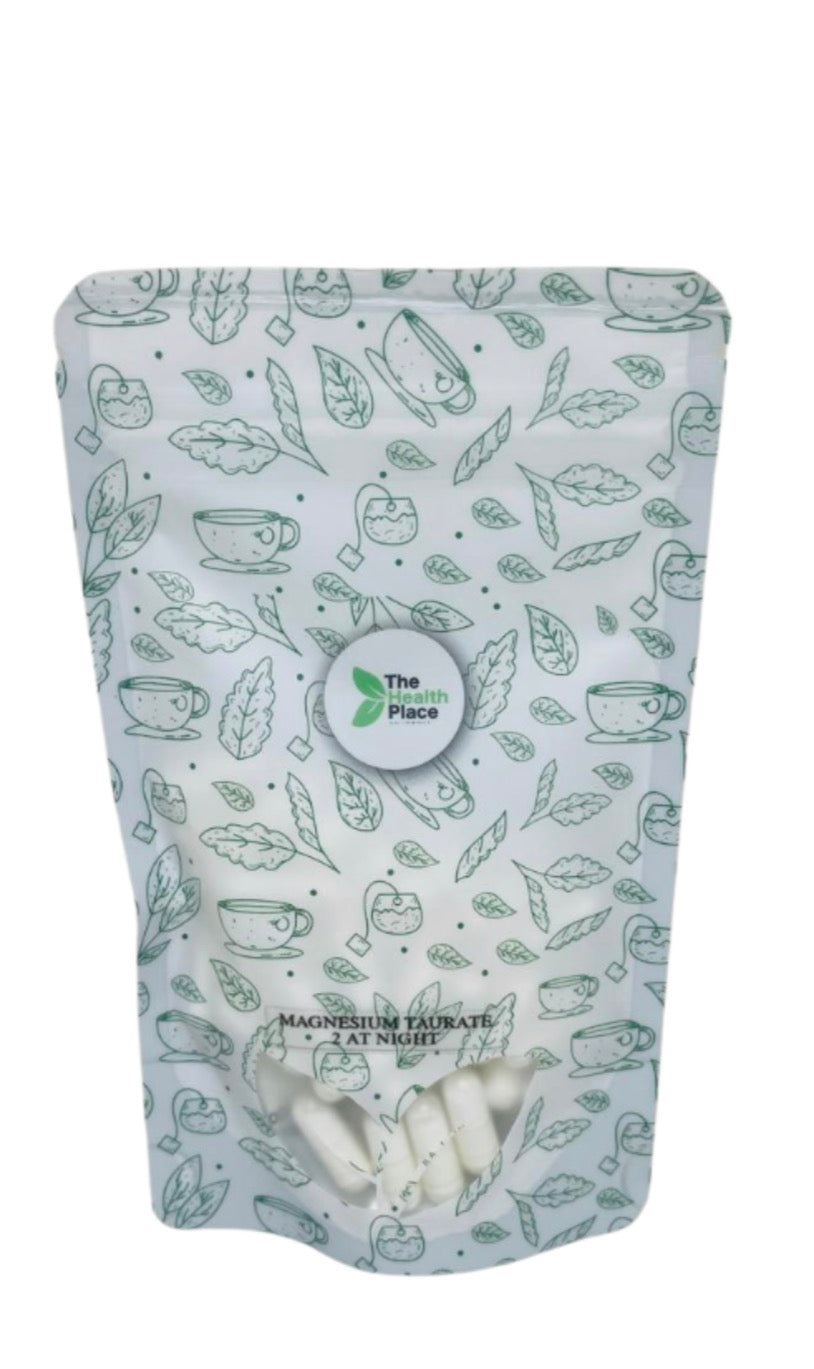
Magnesium Taurate – 50 Capsules, 550mg Each
Each 550mg capsule provides approximately:
49mg Elemental Magnesium
Magnesium Taurate combines magnesium with taurine, an amino-sulphonic acid naturally present in the body.
It is an option for individuals who prefer a taurine-based magnesium compound, particularly those interested in cardiovascular wellness.
Ideal for customers interested in:
- Cardiovascular wellness
- Normal heart and muscle function
- Nervous-system support
- General magnesium supplementation
- A taurine-based magnesium formulation
Magnesium Oxide – 100g Powder
Magnesium Oxide is a magnesium compound consisting of magnesium and oxygen.
Unlike Magnesium Bisglycinate and Magnesium Taurate, Magnesium Oxide is not bound to an amino acid.
Pure Magnesium Oxide contains approximately 60.3% elemental magnesium by weight, giving it a relatively high elemental magnesium concentration. However, it is generally less readily absorbed than several other magnesium forms.
Magnesium Oxide is particularly well known for its osmotic effect within the digestive system.
When used appropriately as an osmotic laxative, it helps retain water within the intestines, softening stools and facilitating bowel movements.
Unlike stimulant laxatives such as senna, Magnesium Oxide works primarily through an osmotic mechanism.
Ideal for customers interested in:
- Bowel regularity
- Occasional constipation relief, where medically appropriate
- A non-stimulant laxative alternative
- Magnesium supplementation where a laxative effect is desirable
- A capsule-free magnesium powder option
For individuals who find stimulant laxatives such as senna uncomfortable, Magnesium Oxide may offer an alternative approach. However, individual tolerance varies, and abdominal discomfort, cramping or diarrhoea may still occur.
Our 100g powder option is particularly convenient for adults who prefer not to swallow capsules and want to measure their recommended serving using an appropriate digital scale.
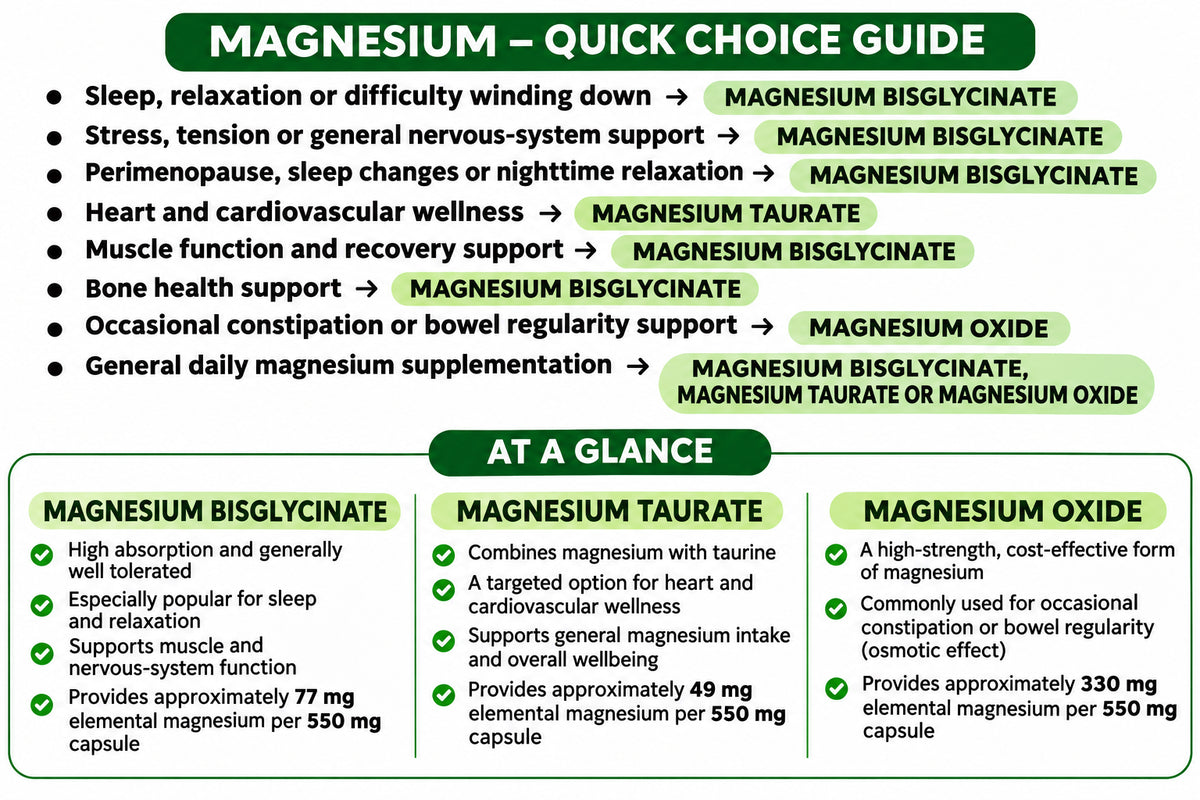
WHICH MAGNESIUM SHOULD I CHOOSE?
Sleep, relaxation or difficulty winding down → Magnesium Bisglycinate
Choose Magnesium Bisglycinate if your primary interest is relaxation, sleep quality or nighttime wellness.
A 2025 randomised, placebo-controlled clinical trial found a modest improvement in insomnia symptoms among adults reporting poor sleep who supplemented with Magnesium Bisglycinate.
Stress, tension or general nervous-system support → Magnesium Bisglycinate
Magnesium Bisglycinate is a practical choice for customers looking to support normal nervous-system function, relaxation and muscle function.
Heart and cardiovascular wellness → Magnesium Taurate
Choose Magnesium Taurate if your preference is a magnesium compound that also contains taurine.
Taurine has been investigated for its potential cardiovascular benefits, including effects on blood pressure and cardiac-function markers.
However, research on standalone taurine should not be interpreted as proof that Magnesium Taurate treats hypertension, heart disease or other cardiovascular conditions.
Perimenopause, menopause and nighttime relaxation → Magnesium Bisglycinate
For women experiencing changes in sleep, muscle tension or difficulty relaxing during perimenopause and menopause, Magnesium Bisglycinate is a practical choice for an evening supplementation routine.
Occasional constipation and bowel regularity → Magnesium Oxide
Magnesium Oxide is the form most directly relevant to customers looking for an osmotic magnesium compound.
Its mechanism differs from stimulant laxatives such as senna. It helps retain water within the intestines rather than working primarily by stimulating intestinal contractions.
Sensitive digestive system without constipation → Magnesium Bisglycinate
If your primary goal is magnesium supplementation without a strong laxative effect, Magnesium Bisglycinate may be a more suitable starting point.
General magnesium supplementation → Magnesium Bisglycinate or Magnesium Taurate
Both forms provide elemental magnesium. Choose according to your individual needs, tolerability and preference for a glycine-based or taurine-based compound.
QUICK CHOICE GUIDE
- Sleep and relaxation → BISGLYCINATE
- Stress and nervous-system support → BISGLYCINATE
- Muscle tension and recovery → BISGLYCINATE
- Perimenopause and sleep support → BISGLYCINATE
- General daily magnesium supplementation → BISGLYCINATE
- Cardiovascular wellness → TAURATE
- Occasional constipation → OXIDE
- Non-stimulant laxative alternative → OXIDE
- Prefer powder instead of capsules → OXIDE POWDER
FREQUENTLY ASKED QUESTIONS
What is Magnesium Bisglycinate?
Magnesium Bisglycinate is a form of magnesium in which magnesium is bound to the amino acid glycine.
It is commonly chosen by people looking for magnesium supplementation alongside relaxation, nighttime wellness, muscle and nervous-system support.
Is Magnesium Glycinate the same as Magnesium Bisglycinate?
The terms are commonly used interchangeably on supplement labels.
Bisglycinate more specifically refers to magnesium bound to two glycine molecules.
If you are searching for Magnesium Glycinate, THP Magnesium Bisglycinate is the glycine-bound form available on this page.
What is Magnesium Taurate?
Magnesium Taurate is magnesium bound to taurine, an amino-sulphonic acid naturally present in the body.
It provides another way to supplement magnesium for customers who prefer a taurine-based rather than a glycine-based formulation.
What is Magnesium Oxide?
Magnesium Oxide, also known by its chemical formula MgO, is a compound consisting of magnesium and oxygen.
It is used in various magnesium supplements and certain laxative and antacid preparations.
It contains a relatively high proportion of elemental magnesium but generally has lower fractional absorption than several other magnesium compounds.
Its osmotic action makes it particularly relevant to bowel regularity.
What is the difference between the three forms of magnesium?
The primary difference is their chemical composition.
- Magnesium Bisglycinate = Magnesium + Glycine
- Magnesium Taurate = Magnesium + Taurine
- Magnesium Oxide = Magnesium + Oxygen
They also differ in elemental magnesium concentration, absorption, gastrointestinal effects and suitability for different wellness objectives.
What does elemental magnesium mean?
Elemental magnesium is the actual amount of magnesium provided by a magnesium compound.
The total weight of the magnesium compound is not necessarily the amount of actual magnesium it provides.
For example:
- 550mg Magnesium Bisglycinate provides approximately 77mg elemental magnesium.
- 550mg Magnesium Taurate provides approximately 49mg elemental magnesium.
- 100mg of pure Magnesium Oxide theoretically provides approximately 60.3mg elemental magnesium.
The actual elemental magnesium content depends on the composition and purity of the raw material.
Does Magnesium Oxide contain more elemental magnesium than Magnesium Bisglycinate?
Yes. Pure Magnesium Oxide contains approximately 60.3% elemental magnesium by weight, which is substantially higher than the theoretical elemental magnesium concentration of Magnesium Bisglycinate.
However, a higher elemental magnesium concentration does not automatically mean better absorption or greater suitability for every wellness objective.
Which magnesium is best absorbed?
Magnesium absorption depends on several factors, including the form, amount consumed and individual digestive health.
Magnesium Oxide generally has lower fractional absorption than several other magnesium forms.
Magnesium Bisglycinate is commonly selected for general supplementation and tolerability. Direct comparative evidence involving Magnesium Taurate remains limited.
Choose your magnesium based on your primary objective rather than elemental magnesium concentration alone.
What are the main benefits of magnesium?
Magnesium is an essential mineral involved in many normal physiological functions, including:
- Normal muscle function
- Normal nervous-system function
- Energy metabolism
- Bone health
- Electrolyte balance
- Normal protein synthesis
- Normal cardiovascular function
Magnesium supplementation can be particularly useful when dietary magnesium intake is inadequate.
Which magnesium is best for constipation?
Of the three magnesium forms available from THP, Magnesium Oxide is the most directly relevant to constipation because of its osmotic effect.
The American Gastroenterological Association and American College of Gastroenterology included Magnesium Oxide as a conditional treatment option in their 2023 clinical guidelines for chronic idiopathic constipation in adults, although the certainty of the evidence was very low.
Consult a healthcare professional if constipation is persistent or recurrent.
How does Magnesium Oxide work as a laxative?
Magnesium Oxide acts as an osmotic laxative when used at an appropriate dose.
It helps retain water within the intestines, which can soften stools and make bowel movements easier.
It does not belong to the stimulant laxative category.
What is the difference between Magnesium Oxide and Senna?
Magnesium Oxide and Senna work differently.
Magnesium Oxide is an osmotic laxative, meaning that its principal action involves increasing water retention within the intestines.
Senna is a stimulant laxative that promotes intestinal movement.
Some individuals experience abdominal cramps or urgency when using stimulant laxatives and may prefer an osmotic alternative.
Can Magnesium Oxide cause stomach cramps?
Yes, although its mechanism differs from that of stimulant laxatives.
Magnesium Oxide may be suitable for some individuals who find stimulant laxatives uncomfortable, but excessive amounts can still cause abdominal cramps, loose stools, nausea or diarrhea.
Can I use Magnesium Oxide every day for constipation?
Magnesium Oxide should not be used as a self-directed laxative for longer than one week without medical advice.
Persistent constipation may have an underlying cause that requires investigation.
Longer-term use may be appropriate under professional supervision.
Can children use Magnesium Oxide?
Certain magnesium-containing laxative preparations may be used in children under appropriate medical guidance.
However, children should not be given adult magnesium servings.
Consult a paediatrician or pharmacist before giving Magnesium Oxide powder or capsules to a child, particularly because concentrated powder requires accurate measurement.
Can Magnesium Oxide help with stomach acidity?
Magnesium Oxide is used as an active ingredient in certain antacid preparations because of its acid-neutralizing properties.
Persistent reflux, stomach pain or indigestion should be medically evaluated.
Is Magnesium Oxide the same as Milk of Magnesia?
No.
Magnesium Oxide is MgO, while traditional Milk of Magnesia contains Magnesium Hydroxide, Mg(OH)₂.
Although both compounds have applications in digestive health, they are chemically different and should not be substituted using identical measurements or serving sizes.
Why does Magnesium Oxide look cloudy when mixed with water?
Magnesium Oxide has low water solubility.
When mixed with water, the powder may form a cloudy, milky-white suspension rather than dissolving completely.
This appearance is expected.
How do I measure Magnesium Oxide Powder?
Magnesium Oxide is a concentrated mineral powder.
Use an appropriately calibrated digital scale to measure the recommended amount accurately.
Ordinary teaspoons and measuring scoops measure volume rather than weight. The actual weight of powder held in a teaspoon depends on its density.
Can I use THP Measuring Spoons for Magnesium Oxide?
THP Stainless Steel Measuring Spoons are convenient for measuring ingredients with volume-based instructions.
Can I take Magnesium Oxide with Psyllium Husk?
Magnesium Oxide and Psyllium Husk work differently.
Magnesium Oxide has an osmotic effect, while Psyllium Husk is a soluble, bulk-forming fibre.
Both may be relevant to bowel regularity, but combining products that affect bowel movements may increase digestive discomfort.
Adequate hydration is particularly important when taking Psyllium Husk. Seek professional guidance before combining laxative products.
When should I take Magnesium Bisglycinate for sleep?
If you are using Magnesium Bisglycinate primarily for relaxation and nighttime wellness, taking it as part of your evening routine is a practical option.
Follow the recommended serving directions on your THP pouch.
Does Magnesium Bisglycinate make you sleepy?
Magnesium Bisglycinate is not a sedative.
Magnesium supports normal nervous-system and muscle function, and many people choose the Bisglycinate form as part of their evening routine.
You should not expect it to act like a sleeping tablet.
Can Magnesium help with stress?
Magnesium is required for normal nervous-system function and participates in physiological processes associated with the body’s stress response.
Adequate magnesium intake can form part of a broader relaxation and stress-management routine alongside sleep, nutrition, exercise and other lifestyle measures.
Can Magnesium help with muscle cramps?
Magnesium is essential for normal muscle contraction and relaxation.
If inadequate magnesium intake contributes to muscle symptoms, correcting that deficiency may be useful.
However, muscle cramps have many possible causes, and magnesium supplementation has not consistently been shown to relieve ordinary muscle cramps.
Persistent or severe symptoms should be investigated.
Can Magnesium support muscle recovery?
Magnesium contributes to normal muscle function, protein synthesis and energy metabolism, making adequate magnesium intake relevant to exercise and recovery.
It should complement adequate protein, hydration, nutrition, rest and appropriate training.
Is Magnesium important for bone health?
Yes.
Magnesium contributes to normal bone structure and is involved in several processes related to calcium and Vitamin D metabolism.
This is also why magnesium is included alongside Vitamin D3 and K2 in THP’s separate Mag-D-K2 formulation.
Why is Magnesium useful during perimenopause and menopause?
Magnesium can be a useful foundational nutrient during perimenopause and menopause because several areas that become increasingly important during midlife depend on adequate magnesium.
These include muscle function, nervous-system function, bone health and general nutritional wellbeing.
Magnesium is not a hormone treatment and should not be presented as a supplement that increases estrogen.
Can Magnesium Bisglycinate help with perimenopause sleep problems?
Magnesium Bisglycinate can be incorporated into an evening routine for women experiencing changes in sleep during perimenopause.
However, perimenopausal sleep disturbance can also be associated with night sweats, hot flashes, anxiety, sleep apnoea and other factors.
Magnesium provides nutritional support rather than treating the underlying hormonal transition.
Is Magnesium Bisglycinate good for women over 40?
It can be a useful nutritional option.
Rather than age alone being the reason to take magnesium, the important considerations are your dietary magnesium intake, existing supplements and individual needs.
Can I take Magnesium Bisglycinate with Glycine?
They can generally be incorporated into the same routine where appropriate.
Magnesium Bisglycinate already contains magnesium bound to glycine, while standalone Glycine Powder provides a separate source of glycine.
Consider your overall supplement routine before combining products.
Can I take Magnesium Bisglycinate with Melatonin?
They serve different functions and can generally be incorporated into the same nighttime routine where appropriate.
Melatonin is involved in sleep timing and the sleep-wake cycle, while magnesium is an essential mineral involved in normal muscle and nervous-system function.
More supplements are not automatically better. Use each for a clear reason.
Can I take Magnesium with Vitamin D?
Yes.
Magnesium and Vitamin D are closely connected nutritionally, and magnesium is involved in Vitamin D metabolism.
THP also offers a separate Magnesium + Vitamin D3 + K2 formulation for customers who specifically want these nutrients together.
Can I take Magnesium with Omega-3?
Yes. They serve different nutritional functions and can generally be incorporated into the same wellness routine.
Does Magnesium Bisglycinate help with constipation?
Magnesium Bisglycinate is not the form we would primarily select for its laxative effect.
Magnesium Oxide is more directly relevant to this objective.
THP also offers Psyllium Husk for customers looking to increase their soluble fibre intake.
Is Magnesium Bisglycinate gentle on the stomach?
Magnesium Bisglycinate is commonly selected because it may be better tolerated by individuals who experience gastrointestinal discomfort with certain other magnesium forms.
Individual tolerance still varies.
Can Magnesium cause diarrhoea?
Yes.
Supplemental magnesium can cause diarrhea, nausea or abdominal cramping, particularly at higher supplemental amounts.
Magnesium Oxide is among the forms commonly associated with laxative effects.
Can I take Magnesium every day?
Magnesium is an essential nutrient, and magnesium supplements are commonly used daily where appropriate.
Daily nutritional supplementation is different from regularly using magnesium as a laxative.
Follow the recommended directions and consider your total magnesium intake from food, supplements and magnesium-containing medications.
Can I take Magnesium in the morning?
Yes. Magnesium does not have to be taken at night.
If your main objective is sleep or evening relaxation, nighttime may be more practical.
If you are primarily supplementing your dietary magnesium intake, consistency is generally more important than a particular time of day.
Should I take Magnesium with food?
Magnesium supplements can generally be taken with food, and doing so may improve gastrointestinal tolerance for some individuals.
Follow the specific directions for your selected form.
Can I take Magnesium Bisglycinate and Magnesium Taurate together?
There is usually no need to take both simply because both are available.
Both provide magnesium, so combining them increases your total supplemental magnesium intake.
Choose the form that best matches your primary needs unless a healthcare professional has given you a specific reason to combine them.
Can I take Magnesium Oxide alongside Magnesium Bisglycinate or Magnesium Taurate?
The different forms may be used for different purposes, but all contribute to your total elemental magnesium intake.
Do not automatically combine multiple magnesium products without accounting for their elemental magnesium content.
Seek professional guidance, particularly if you are using Magnesium Oxide for its laxative effect.
How much magnesium is too much?
The US National Institutes of Health identifies 350mg per day as the tolerable upper intake level for magnesium from supplements and medications for adults.
This limit does not include magnesium naturally occurring in food.
Higher amounts may sometimes be prescribed for specific medical purposes under professional supervision.
The amount of the magnesium compound and its elemental magnesium content must not be confused.
Can I take Magnesium with prescription medication?
Magnesium can interfere with the absorption of certain medicines, including some antibiotics, thyroid medications and oral bisphosphonates.
If you take regular prescription medication, ask your pharmacist or healthcare professional how far apart your medication and magnesium should be taken.
Who should be particularly careful with Magnesium supplements?
People with impaired kidney function should not routinely supplement magnesium without appropriate medical guidance.
The kidneys play a major role in regulating magnesium levels.
Magnesium Oxide should also not be used for self-treatment if you have severe or unexplained abdominal pain, vomiting, suspected bowel obstruction or rectal bleeding.
Can I take Magnesium during pregnancy or breastfeeding?
Magnesium is an essential nutrient during pregnancy and breastfeeding.
However, supplementation should take account of your total intake from food, prenatal supplements and other magnesium products.
Discuss additional supplementation, particularly Magnesium Oxide for constipation, with your healthcare professional.
How do I choose between this product and THP Mag-D-K2?
Choose Magnesium Bisglycinate if you want a standalone glycine-bound magnesium supplement, particularly for relaxation, nighttime wellness, muscle and nervous-system support.
Choose Magnesium Taurate if you prefer a taurine-based magnesium compound.
Choose Magnesium Oxide if your primary interest is its osmotic properties and suitability for bowel regularity.
Choose Mag-D-K2 if you specifically want Magnesium + Vitamin D3 + Vitamin K2 together, particularly where bone health and calcium utilisation are priorities.
Check your existing supplements before combining products so you do not unintentionally duplicate ingredients.
How many capsules are in each pack?
Our capsule options contain 50 capsules per pack.
Our Magnesium Oxide Powder is available in a 100g pouch for customers who prefer a capsule-free option.
Where can I buy Magnesium Glycinate, Magnesium Taurate or Magnesium Oxide in Nigeria?
THP Magnesium Bisglycinate, Magnesium Taurate and Magnesium Oxide can be ordered online from The Health Place Africa for delivery within Nigeria.
For help choosing between the two forms or incorporating magnesium into your supplement routine, WhatsApp us Monday to Friday, 11am–4pm.
STORAGE
Store in a cool, dry place away from direct sunlight and moisture.
Keep the pouch tightly sealed after opening.
Always use clean, completely dry utensils when handling powder.
Keep out of reach of children.
Premium Quality
No fillers, flow agents, or preservatives
• Imported 100% raw from trusted sources ✔
• Carefully Packed in Nigeria ✔
• ISO 22000:2018 Certified ✔
• SGS cGMP (21 CFR Part 111) Certified ✔
• Halal & Kosher Certified ✔
• Non-GMO ✔
All our products are 100% natural, produced under globally recognized certifications, and processed in FDA-registered, GMP-certified facilities.
Statements regarding dietary supplements have not been evaluated by the FDA and are not intended to diagnose, treat, cure, or prevent any disease or health condition.

Choose options